Open source · Reference build · 2026
A Linear-style issue tracker, open source
A keyboard-first, real-time, multi-tenant issue tracker on Next.js 16, Prisma and PostgreSQL. Deployed and open source, so you can read exactly how I structure a production application today.
- Role
- Solo build
- Timeline
- Reference build, maintained
- Team
- 1
- Platform
- Web
Why this exists
Clients reasonably ask what my code looks like, and almost all of my client work is private. This is the answer: a complete, deployed issue tracker modelled on Linear, with the parts that are usually hand-waved in demos actually implemented and tested.
- Live: linear-clone-pearl.vercel.app (sign in with GitHub or GitLab; no passwords are stored)
- Source: github.com/MuhammadAdnanRiaz/linear-clone
What it does
- Issues with status, priority, assignee and labels; create, update, filter and search.
- Projects with list and board views. Cycles as time-boxed sprints whose state (upcoming, active, completed) is derived from dates, not stored.
- Keyboard-first:
J/Kto move,Cto create,Enterto open,Escapeto close,Cmd+Kfor everything else. - Command palette with structured queries such as
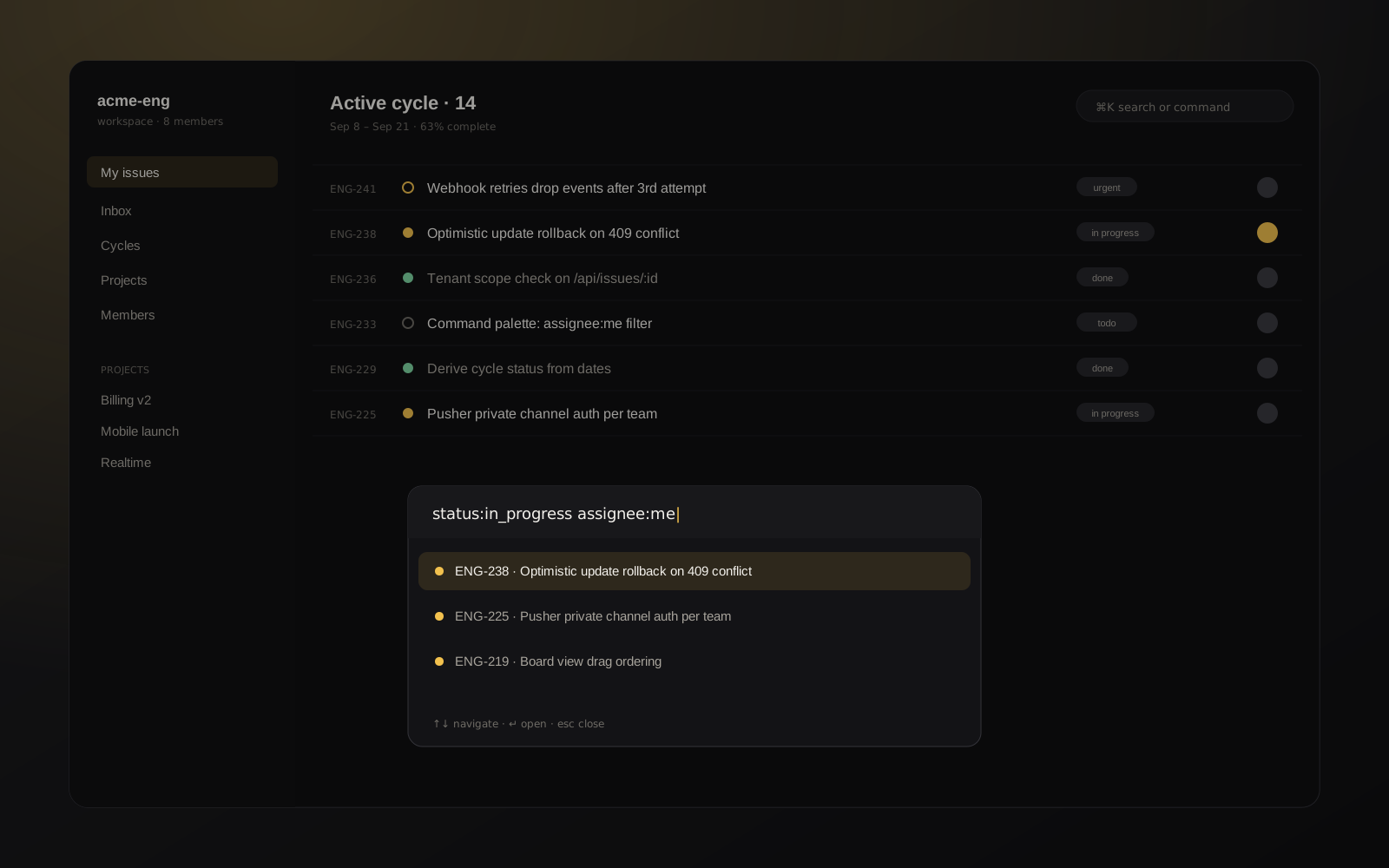
status:in_progress assignee:me, plus navigation to any issue, project or member. - Real-time collaboration: a change made by another user appears instantly over Pusher private channels.
- Optimistic updates on every mutation, reverted cleanly when the server rejects.
- Multi-team workspaces with strict tenant isolation enforced server-side.
- Activity timeline per issue: status changes, assignments, priority changes and comments.
- OAuth only (GitHub, GitLab) through Auth.js v5.
Decisions worth noting
Tenant isolation lives on the server
Every query is scoped by the authenticated user's team membership inside the API layer. The client never sends a team id that the server trusts. This is the line between a demo and something you could run for real customers, and it is the first thing I check when I take over someone else's multi-tenant codebase.
Optimistic UI, with the failure path tested
Mutations update the TanStack Query cache immediately and reconcile with the server response. The rollback path is where optimistic interfaces usually fall apart, so it is tested explicitly: reject the mutation and the UI must return to exactly the previous state.
Real-time as a layer, not a rewrite
Pusher events invalidate or patch the query cache. Turn real-time off and the application still works correctly, just without the instant updates. Keeping the data flow simple to reason about matters more than any single feature.
Typed end to end
Prisma schema, Zod validation at the API boundary, TypeScript through the interface. Refactors are safe because the compiler finds the seams before a user does.
Derived state over stored state
A cycle's status is computed from its dates at read time. Storing it would mean a scheduled job to keep it correct, and a class of bugs when that job fails. Where a value can be derived cheaply, it is.
Deployment and operations
Vercel for the application, Neon for PostgreSQL with separate pooled and direct connection strings, Pusher for websockets. The README documents every environment variable and a HOW_TO_DEPLOY.md covers each service, so anyone can stand it up from a clean checkout.
What this is evidence of
How I structure a Next.js application in 2026: App Router, server-enforced authorisation, typed boundaries, real-time done simply, and documentation that lets someone else deploy it. If you are evaluating engineers by reading code, start here.